
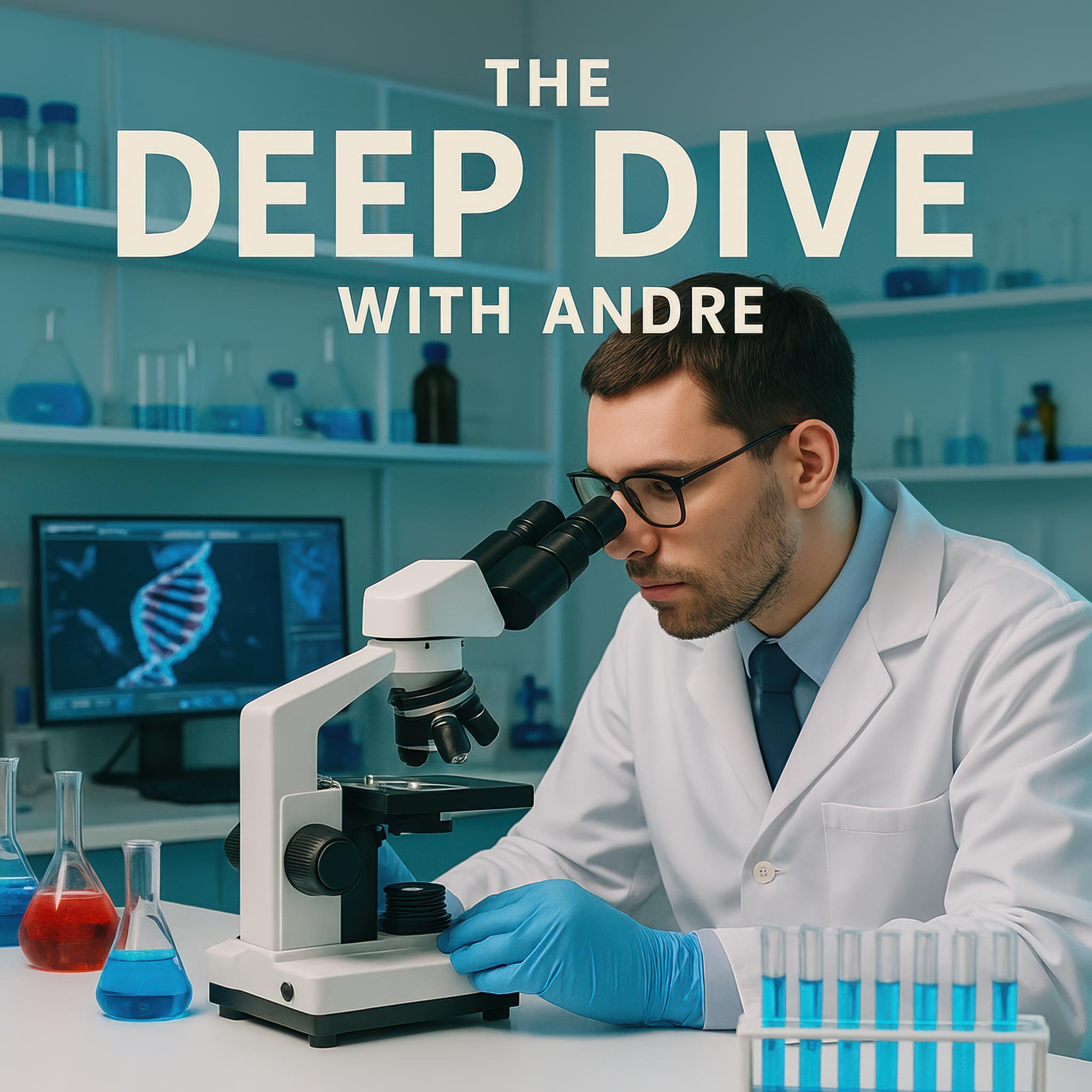
This podcast channel delivers in-depth, educational content across a broad range of topics. A large collection of episodes are available to you, the oldest being as relevant as the newest since this channel is not about daily news. Each episode runs between 30 and 120 minutes and is intentionally designed to go beyond casual listening. The research behind every episode is conducted with the support of advanced artificial intelligence and presented by two AI-generated hosts.
If you’re uncomfortable with the use of cutting-edge AI as both researcher and presenter, this podcast may not be for you. Its mission is to provide access to expert-level knowledge—insights that are typically out of reach through simple web searches or general-purpose AI tools.
“The Deep Dive with Andre” is not about connecting with the personality and voice of a human podcaster — it’s about connecting with expert-level knowledge, for those who value insight over persona. At times, the generated virtual hosts may exhibit an inappropriate voice tone, which can be disconcerting. The technology is still evolving.
Unlike traditional Text-to-Speech (TTS) services, the experimental AI powering the virtual hosts develops an independent understanding of the input information before generating speech. While the resulting voices do not match the quality of those produced by services like ElevenLabs, the AI’s ability to generate dynamic dialogues between two virtual hosts is a distinctive feature. Also, the cost of high-quality voiceovers would be astronomical, given the length of each episode (30 to 120 minutes). Quantity takes precedence over voice quality, given the vast knowledge conveyed by the episodes.
Note: When the hosts mention the “report,” “sources,” or “text,” they are unknowingly referring to the in-depth research and analysis generated by the first-stage AI. That output is then passed on to the second-stage AI, which handles the virtual hosts.
Disclaimer: This content is intended for educational purposes only and should not be construed as professional advice. It is derived exclusively from publicly available sources. No proprietary, confidential, or non-public information has been used in their preparation. However, through deep analytical synthesis, it is possible that some insights or conclusions presented here represent emergent interpretations that have not yet been formally published or broadly disseminated within the scientific and technological communities.
Please share your comments here:
https://the-deep-dive-with-andre.podbean.com
That would help improving this podcast show. Some podcast apps give direct access to the episode website.
Available on Amazon Music, Apple Podcasts, Audible, Castbox, Castro, Deezer, Goodpods, iHeartRadio, MyTuner, Overcast, Player FM, Pocket Casts, Podbean, Podcast Addict, Spotify, TuneIn Radio and others.
Episodes
Sunday Jun 29, 2025
Sunday Jun 29, 2025
The provided source, "Space Weaponization: Defense and Treaties," offers a comprehensive overview of the evolving military landscape in outer space. It distinguishes between the historical militarization of space, involving support functions like surveillance and communication, and the more recent and concerning weaponization, which entails deploying offensive capabilities. The text analyzes the doctrines and assets of major space powers—the United States, China, and Russia—highlighting their differing approaches to space as a warfighting domain. Furthermore, it examines the limitations of existing international law, particularly the 1967 Outer Space Treaty, in addressing modern counterspace threats and discusses the catastrophic consequences of kinetic space warfare, emphasizing the need for resilience and new diplomatic efforts to manage this increasingly contested frontier. Finally, the source explores future trajectories, including the impact of commercialization and artificial intelligence, and provides strategic recommendations for policymakers navigating this complex environment.
Research done with the help of artificial intelligence, and presented by two AI-generated hosts.
No comments yet. Be the first to say something!